DeepDiligence
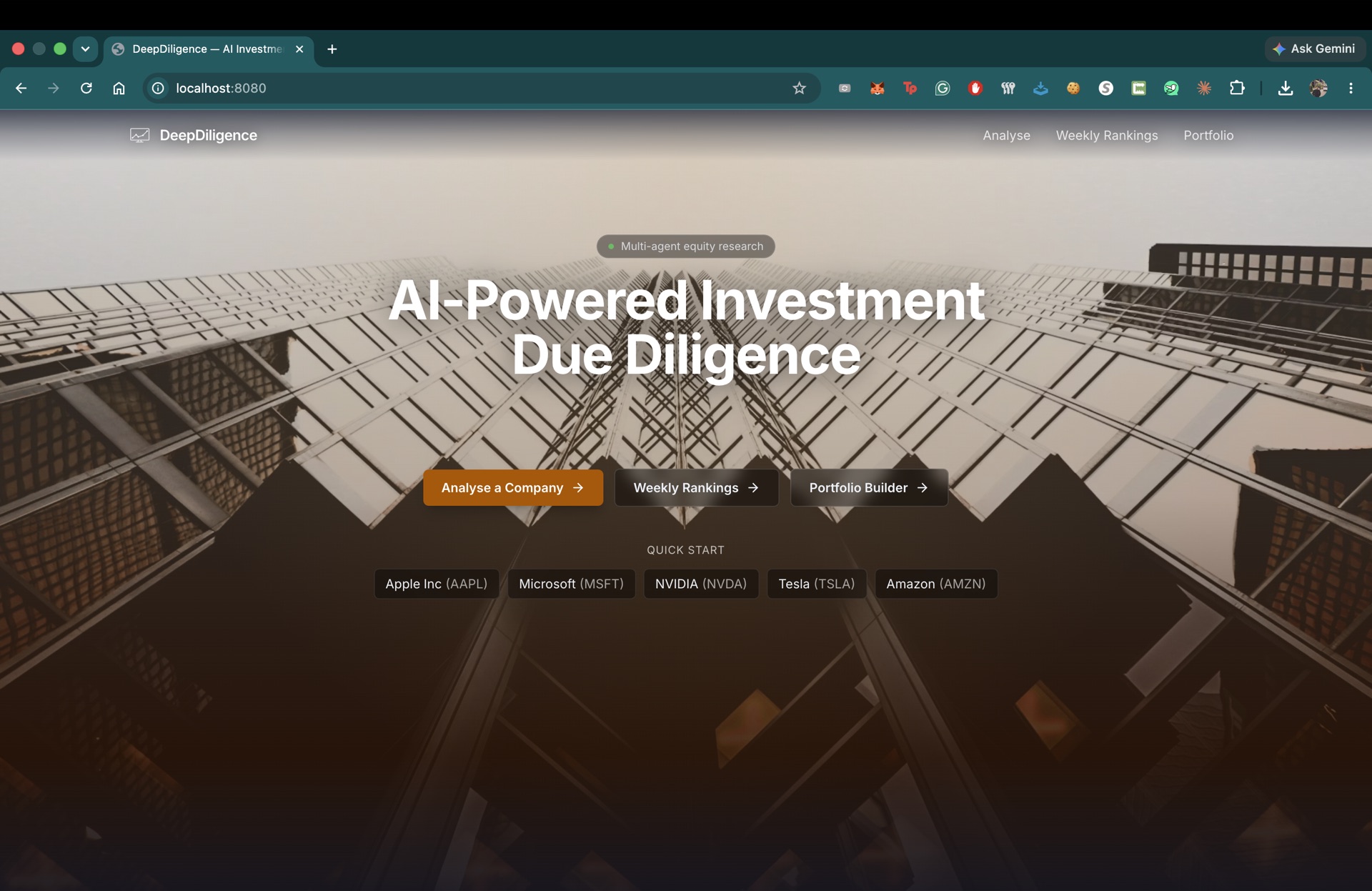
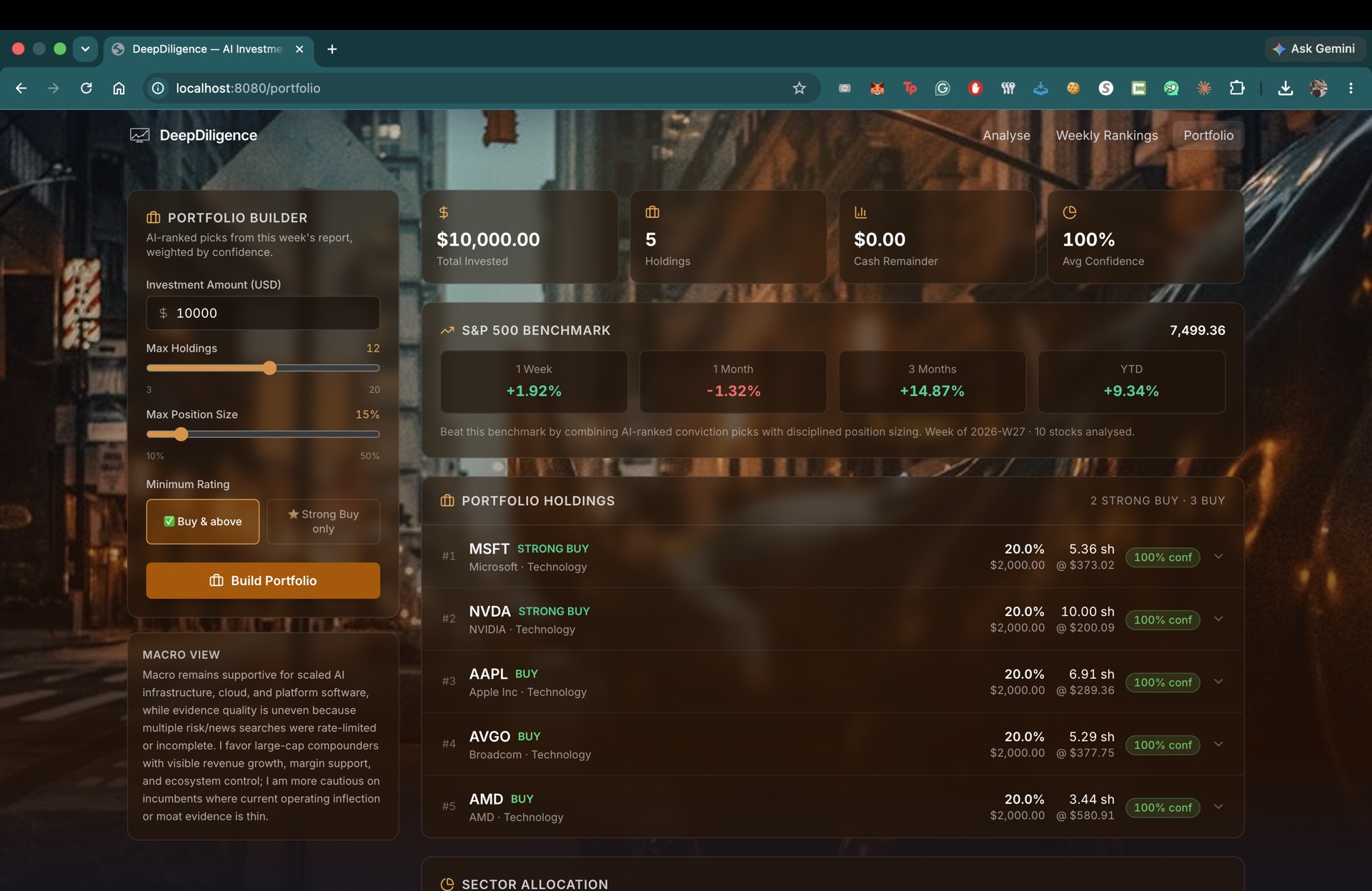
A multi-agent system for investment due diligence. Five specialist agents run in parallel, and a synthesis agent reconciles their findings into a cited investment memo with confidence scores and conflict detection. A portfolio builder then allocates capital from the AI ratings, using live prices and S&P 500 benchmarking.
A working recreation you can click through
Everything here is DeepDiligence's own output. Analyse replays five real runs from its cache (April–May 2026): the agents' actual findings, confidence scores, citations and flagged conflicts. Weekly rankings replays four saved reports. The portfolio builder runs the real allocation formula on those ratings in your browser. Only the timing is simulated; nothing is sent anywhere.
Overview
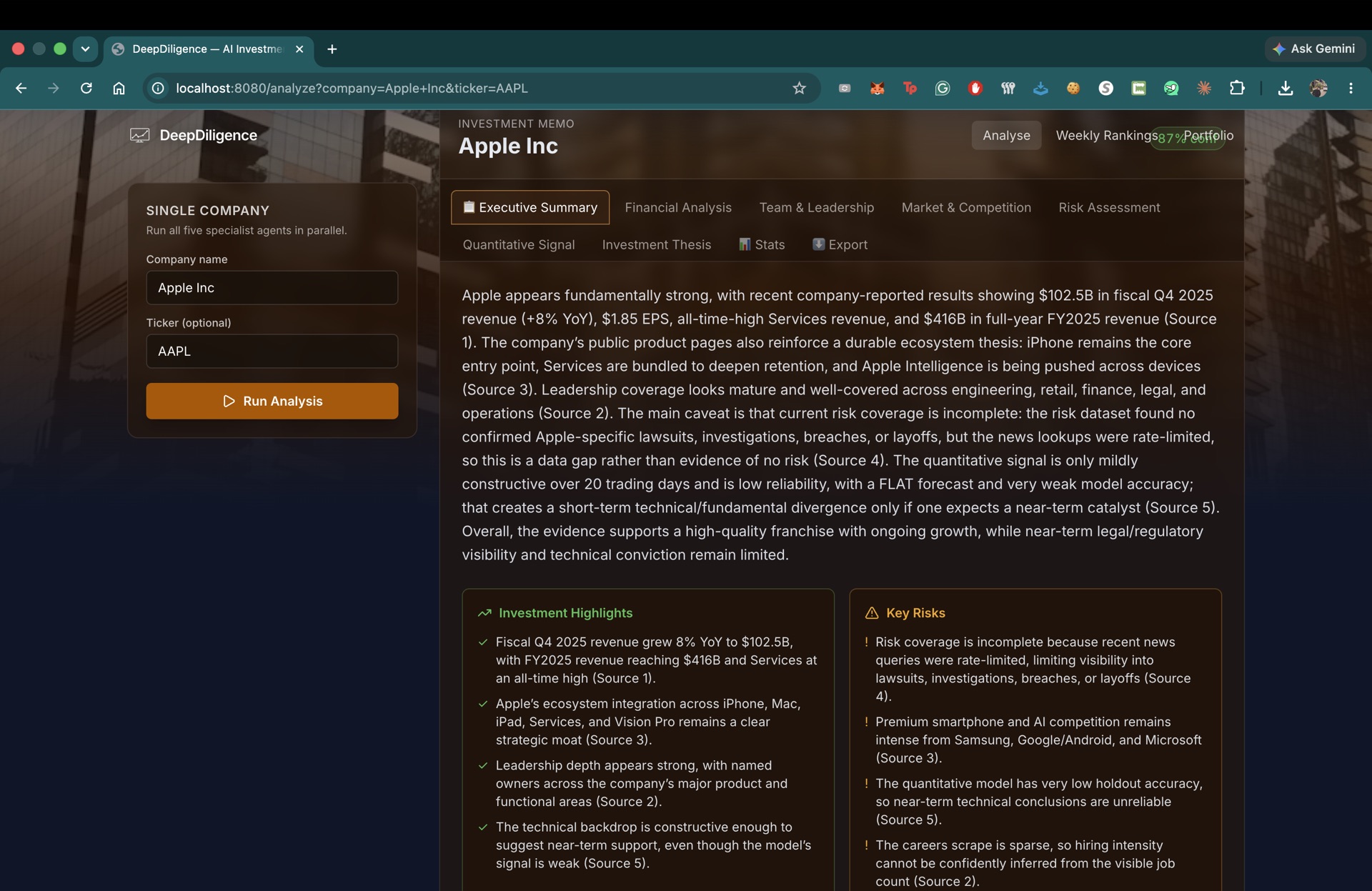
DeepDiligence is a multi-agent AI system for investment due diligence, built as the final project for Cornell's ENMGT5400. A user enters a company name; five specialist agents run in parallel; a synthesis agent reconciles their findings; and the result is a structured investment memo with source citations, confidence scores, and conflict detection.
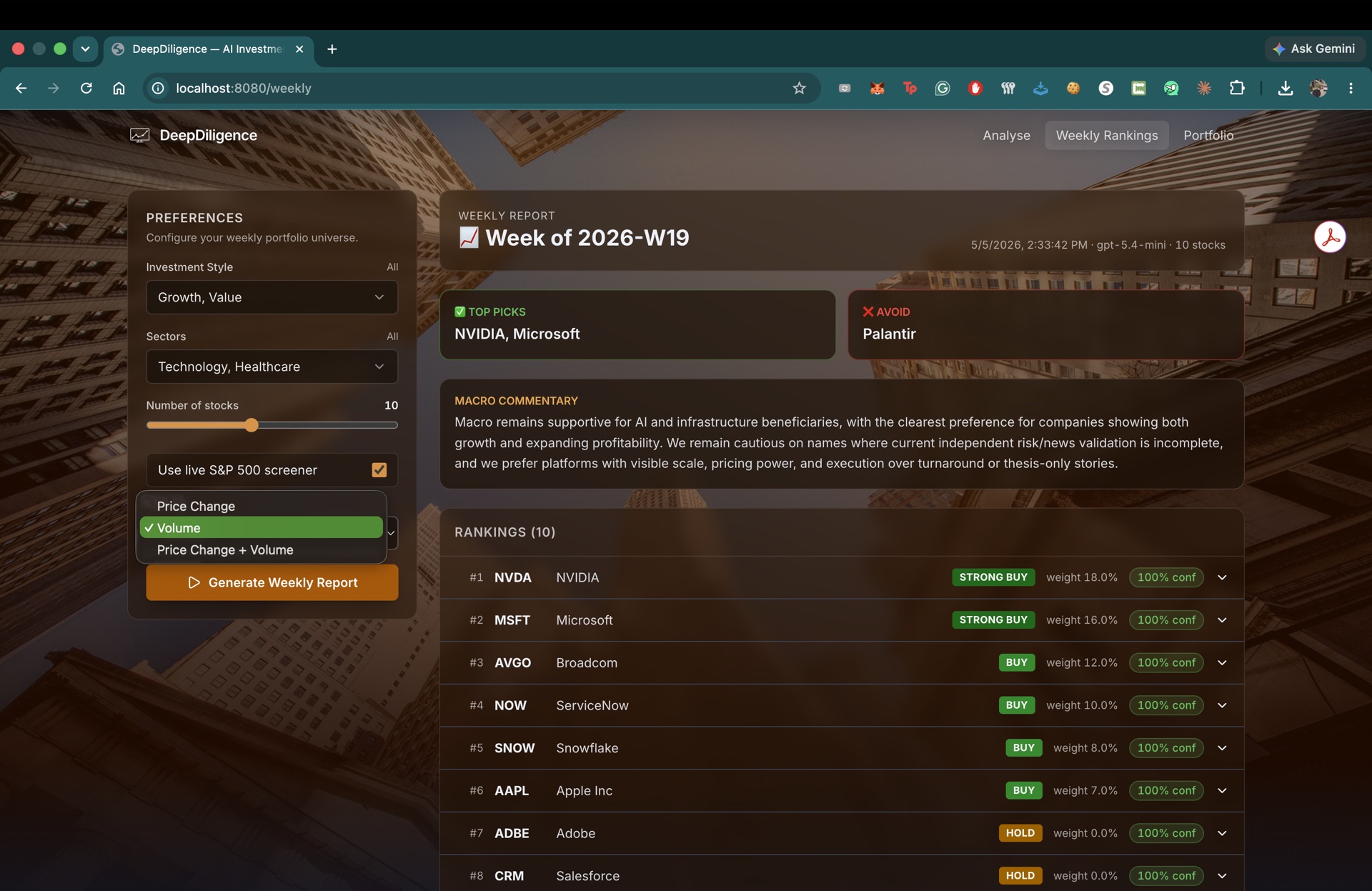
On top of the single-company analysis, it also produces weekly stock rankings across a 95-stock universe and a portfolio builder that allocates capital based on AI ratings, with live prices and S&P 500 benchmarking. This is v1.0 — complete and deployed.
Problem
Investment due diligence means pulling together financials, competitive positioning, team signals, risk factors, and market data from dozens of scattered sources — then reconciling them into a defensible recommendation. It's slow, inconsistent, and hard to audit: when a conclusion is wrong, it's rarely clear which underlying claim drove it.
Solution
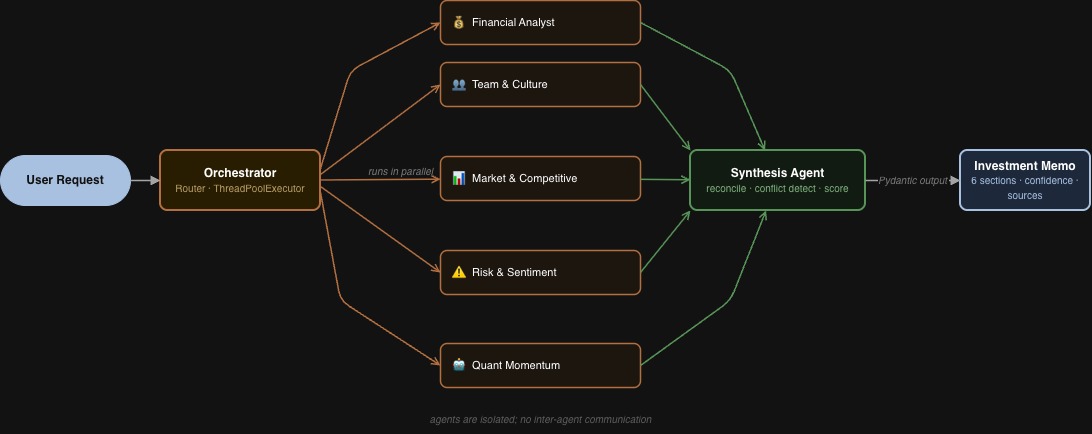
A router/aggregator pipeline that fans a request out to five isolated specialist agents and reconciles their structured outputs into an auditable memo:
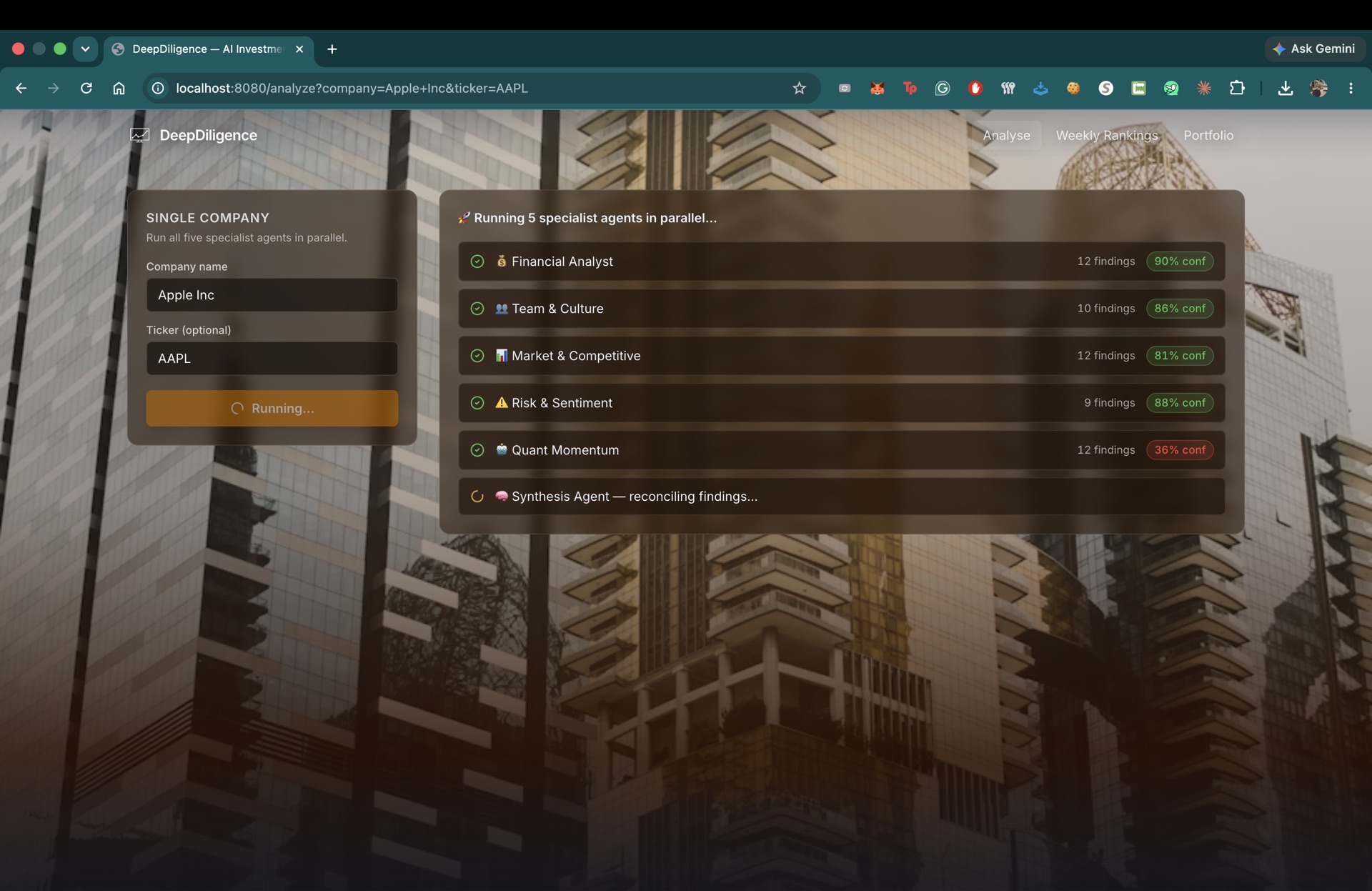
- Parallel specialists — financial, team/culture, market/competitive, risk/sentiment, and a quantitative ML agent run concurrently
- Isolation by design — agents cannot talk to each other; each returns a typed sub-report
- Reconciliation — a synthesis agent sees only the structured sub-reports (never raw documents), detects contradictions, and scores confidence
- Traceability — every claim in the final memo carries at least one source id
- Beyond one company — weekly BUY/HOLD/SELL rankings across 95 stocks, plus an AI-rated portfolio builder benchmarked to the S&P 500
Architecture: Router / Aggregator
An orchestrator dispatches five agents concurrently (ThreadPoolExecutor, 5 workers), then gates a synthesis step:
- Financial Analyst → SEC EDGAR filings, investor-relations pages
- Team & Culture → job postings, leadership signals
- Market & Competitive → competitors, TAM, positioning
- Risk & Sentiment → news sentiment, litigation, macro flags
- Quantitative Momentum → Random Forest ML on 3yr OHLCV + 14 technical indicators
Each agent returns a typed AgentSubReport. The Synthesis Agent merges those into a Pydantic InvestmentMemo — six sections, per-claim source ids, and an overall confidence score. Because agents are fully isolated and synthesis only ever sees structured reports, bias can't propagate and every output stays auditable.
The Quantitative Agent
Unlike the four LLM tool-calling agents, the quant agent is pure ML:
- Downloads 3 years of OHLCV via yfinance, then engineers 14 features — RSI, MACD, Bollinger position, MA20/50/200 crossovers, multi-window momentum, ATR, and volume z-score
- Trains a
RandomForestClassifier(300 trees, depth 6, balanced classes) on an 80/20 time-ordered split — no shuffling, to prevent look-ahead bias - Calibrates confidence conservatively (caps reported confidence at 0.75) and returns a zero-confidence stub for private companies with no ticker
Portfolio Builder
Allocates capital from the latest weekly report:
raw_weight = suggested_weight_pct × rating_boost × confidence
# STRONG BUY = 1.5×, BUY = 1.0×
Weights are then capped and iteratively re-normalized (excess redistributed from capped positions), live prices are fetched per request via yfinance, and results are benchmarked against the S&P 500 across 1W/1M/3M/YTD.
Tech Stack
- Backend: Python 3.11, FastAPI + uvicorn, Server-Sent Events for real-time agent progress
- LLM: Anthropic Claude API (
claude-sonnet-4-20250514) - ML: scikit-learn
RandomForestClassifier, numpy - Data: yfinance, SEC EDGAR, NewsAPI, BeautifulSoup scraping
- Frontend: React + TypeScript, TanStack Router, Tailwind CSS
- Contracts: Pydantic models for every inter-agent boundary
- Caching: disk-based, SHA256-keyed JSON per agent per company
Results
- Full five-agent memo generated per company, every claim traceable to a source
- Weekly rankings across a curated 95-stock universe with BUY/HOLD/SELL ratings
- AI-rated portfolio construction benchmarked live against the S&P 500
- 54 unit tests; complete and deployed as v1.0
What's Next
- RAG faithfulness verifier (ChromaDB is in the stack, not yet wired up)
- Cross-week memory so past memos persist in a vector store
- Post-memo Q&A interface
- Universe expansion beyond 95 stocks
A closer look
- AI product · Decision toolingBlueprint: the Agent Architecture Guide
- Systems engineering · EnergyTransformer Capacity Monitor
- LLM pipeline · HealthcarePolicy-to-Rules Engine
- Multi-agent · SalesLead Generator Proposal Engine
- Agentic AICornell Personal Assistant
- AutomationJob Listings Tracker
- AutomationInvoice Generator
- GenAI · ConversationalTravel Agent GPT